
 Business License

Packing and Shipping Carbide Scraper Blades Without Edge Damage
1. Why Scraper Blade Packing Is an Edge Problem Before a Box Problem
Scraper blade packing is judged by one feature, and that feature is a few microns wide. A carbide scraper blade is a body with an edge, and the body can be scratched, dropped and stored badly without any consequence. The edge cannot. A blade that arrives with a chipped land is scrap, and the scrap value of carbide does not begin to cover the cost of the line that was waiting for it.
The scale is what makes this difficult. A finishing land on a scraper blade runs 0.02 to 0.05 mm, which is thinner than a human hair and thinner than the paint on most packaging. Anything that touches that land in transit with more force than a fingernail can apply will damage it, and the damage is often invisible until the blade is in the holder.
Winray New Materials ships blades into tube mills in several regions, and the packing lesson that comes back from those shipments is consistent. The failures are not exotic. They are blades that touched each other, blades that moved inside a box, and blades that sat in a humid container for six weeks.
2. Carbide Blade Shipping Damage: The Four Ways It Happens
Carbide blade shipping damage happens in four ways, and each one has a different fix. Blades chip against each other when they are loose in a box, against the box when it is dropped, and against a hard insert that was meant to protect them. They corrode at the edge when moisture sits on the surface for long enough.
The first is the most common and the easiest to prevent. Two blades in contact will move against each other under vibration, and the contact point is nearly always the edge, because the edge is the highest feature on the part. Once a blade has a chip on the land it will mark the tube, and the mill finds out at the first coil rather than at the dock.
The table sets out the four mechanisms with the force or condition that causes each, because the fix follows from the mechanism rather than from the packaging catalogue.
| Mechanism | What causes it | Where it shows |
|---|---|---|
| Blade to blade contact | Loose parts under vibration | Edge corner, both parts |
| Drop impact | Box dropped from handling height | Edge or body corner |
| Hard insert contact | Rigid packing pressing on the edge | Line along the land |
| Corrosion | Moisture held against the surface | Surface pitting near the edge |
Drop impact is the mechanism that packaging tests are meant to cover, and the figure that matters is the height rather than the force. A carton that is dropped from 1.2 m onto a corner delivers a load that no soft insert can absorb in full, and the design aim is to keep that load away from the edge rather than to cushion it entirely. That is why the blade is held so the edge faces a void, and why a box that is packed tightly enough to stop movement can still be damaged by a drop.
3. Blade Edge Protection Packing: What Has to Touch What
Blade edge protection packing is a set of rules about contact rather than a material choice. The edge has to touch nothing rigid, the body has to be held so the edge cannot reach the box wall, and the packing has to be soft enough to absorb a drop and firm enough to stop movement. Those three requirements conflict, and the resolution is a two layer arrangement.
The inner layer holds each blade separately and touches the body rather than the edge. The outer layer absorbs impact and keeps the inner layer from reaching the box. A single layer of foam around a blade does both jobs badly, because the foam that is soft enough to absorb a drop is soft enough to let the blade move.
The rule that matters most is that nothing rigid touches the land. A cardboard slot, a plastic tray with a sharp edge or a wooden block will all mark a carbide edge under the pressure of a stack, and the mark is a chip in everything but name. Winray uses a soft slot and keeps the land facing a void rather than a surface.
4. The Edge Guard in Blade Edge Protection Packing
The edge guard is the part of blade edge protection packing that customers ask about and rarely specify. It is a soft channel that sits over the land and takes any contact that would otherwise reach the edge, and it has to be made of something that yields before the carbide does.
In blade edge protection packing a guard that is too hard transfers the load. A guard that is too soft falls off in transit and the blade arrives with the guard loose in the box and the edge unprotected. The working material is a closed cell foam of 2 to 5 mm wall, held by friction rather than by adhesive, because an adhesive that fails leaves a residue on the land that has to be cleaned before the blade is used.
The guard in a blade edge protection packing system also has a second function worth stating. It makes the blade visibly protected at the receiving dock, which changes how the carton is handled. A blade wrapped in a plain sleeve looks like a metal part. A blade with a guard on the edge looks like an edge, and handlers treat it accordingly.
5. Moisture, VCI and Carbide Blade Shipping Damage
Carbide blade shipping damage from moisture is the mechanism that surprises most buyers, because carbide does not rust. The cobalt binder does. A carbide part in a humid environment develops surface pitting where the binder at the surface reacts, and the pitting at the edge is what turns into a chip under load.
The condition behind that form of carbide blade shipping damage is not rain. It is a container that cycles between warm days and cool nights, which drives moisture onto cold metal and holds it there. A blade in a sealed plastic bag with humid air inside it sits in that condition for the whole voyage, and the bag that was meant to protect it becomes the container that keeps the moisture in.
The fix is either a desiccant in a sealed barrier or a vapour phase inhibitor, and the two are not interchangeable. A desiccant absorbs what is already in the bag and is exhausted after a few days. An inhibitor keeps working as long as it is present. For a shipment that will be in transit for six weeks, Winray uses an inhibitor and a barrier bag rather than a desiccant alone.
The barrier is the part of the arrangement that is easiest to get wrong and hardest to see. A plain polythene bag is not a barrier, because it passes moisture vapour at a rate that a six week voyage will use. A metallised film or a foil laminate passes a small fraction of that, and the inhibitor inside it lasts correspondingly longer. Winray states the barrier type on the packing note so a repeat order does not quietly downgrade to a plain bag.
6. Packing by Quantity: Single Blade, Set and Bulk
Packing by quantity changes the arrangement rather than the rule. A single blade ships in a rigid tube or a shaped block with the edge facing the void. A set of blades for one mill ships in a segmented tray where each blade has its own slot. A bulk order ships in layers separated by foam, with no layer more than about five blades deep.
The bulk case is where most damage happens, because the packing that suits five blades does not scale to fifty. A stack of blades separated by paper and nothing else will compress under its own weight in a carton that is handled roughly, and the blades at the bottom of the stack take the load. Separating every fifth blade with a foam sheet and limiting the stack height is what keeps the arrangement working.
The case that shows it came from a mill that ordered sixty blades some time ago and received them in three cartons of twenty, each stacked flat. Two blades in the bottom layer of the second carton arrived with chipped corners and the carton showed no external damage. The stack had compressed in a truck, and the load path ran through the edges rather than through the bodies.
7. Receiving Inspection After Scraper Blade Packing
Receiving inspection after scraper blade packing is a short procedure, and it has to happen before the carton is broken down and the packing thrown away. Once the packing is gone, a claim about transit damage cannot be supported, because nobody can show how the blade was held.
The check is visual and takes a minute per blade. Look at the land under a magnifier for a chip, a line or a burr, at the body for contact marks that show where the blade was touching something, and at the guard for signs that it moved. Then photograph the blade in its packing if there is any damage, because the photograph of the packing is what a carrier accepts.
Winray New Materials asks customers to photograph the carton before opening it and the packing before removing the blade, and the request is not administrative. A claim that is filed with those two photographs is settled in days, and the same claim filed with a photograph of a damaged blade alone is usually rejected.
8. What a Scraper Blade Packing Specification Should State
A scraper blade packing specification should state four things, and most purchase orders state none of them. The four are the guard material and wall, the number of blades per inner pack, the maximum stack height, and the moisture protection. Each one is a line on the order rather than a conversation after the first claim.
The guard material matters because the buyer and the supplier may have different ideas about what soft means. A specification that names a closed cell foam of 2 to 5 mm and a friction fit removes the ambiguity. The stack height matters because it sets the load path, and the moisture protection matters because it is the item most often left to the supplier's judgment.
Winray New Materials Co Ltd writes those four lines onto the packing note for every blade order, so the arrangement that was used can be repeated and a change can be traced. A packing method that is not written down is a method that changes with whoever is on the packing bench that week.
9. Frequently Asked Questions on Scraper Blade Packing
9.1 What is the main cause of carbide blade shipping damage?
Blade to blade contact under vibration, ahead of drops and moisture. Two carbide edges in contact will move against each other in any vehicle, and the contact point is the land because it is the highest feature on the part. The damage appears as a small chip on a corner and it is often invisible through the packing. Separating every blade in its own soft slot and keeping the land facing a void removes the mechanism almost entirely, and it costs less than the first claim.
9.2 Does scraper blade packing need a desiccant or a VCI?
For a voyage longer than a few weeks, an inhibitor. A desiccant absorbs the moisture that is already inside the bag and is exhausted within days, after which the bag holds whatever comes through the film. A vapour phase inhibitor keeps releasing for as long as it is present and protects the cobalt binder at the surface rather than the air around it. The failure that the two prevent is pitting near the edge, which becomes a chip once the blade is loaded.
9.3 How should a bulk order of blades be stacked?
In layers separated by a foam sheet, with no more than about five blades between separators and a total stack that the carton can carry without compressing. The load path should run through the blade bodies rather than through the edges, which means the blades lie flat and the separators take the weight. A stack of fifty blades separated by paper and nothing else will compress in a truck, and the blades at the bottom take the load through their edges.
9.4 What should be checked on receipt before the packing is discarded?
The carton exterior first, then the packing, then the blade, in that order and with a photograph at each stage. The carton photograph shows whether the damage happened in transit, the packing photograph shows how the blade was held and whether it moved, and the blade photograph shows the chip. A claim supported by all three is usually settled quickly, and the same claim supported by the blade alone cannot show whether the damage happened before or after dispatch. Open the carton where the light is good, because a chip on a land is a fraction of a millimetre wide and a dim dock turns a claim into an argument.
Recently Posted
-
Carbide Punch Pins in Progressive Die Piercing of Sheet Metal
November 18, 20261. Progressive Die Punch Pin Loads at 300 Strokes a Minute A progressive die punch pin does not do one job. It does the job of its Read More
-
How to Order Custom Carbide Punch Pins From a Drawing
November 17, 20261. Why a Punch Pin Drawing Carries More Than a Part Number A part number describes a pin that already exists. Beyond the standard
Read More -
Solid Carbide Punch Pin vs Coated Punch: Which Holds Diameter Longer
November 17, 20261. Why a Solid Carbide Punch Pin and a Coated Punch Are Compared Wrong A solid carbide punch pin is usually compared with a coated Read More
-
Carbide Punch Pin vs HSS Punch: Wear Life per 100,000 Strokes
November 17, 20261. Why Punch Cost per Stroke Is a Better Question Than Pins per Year A terminal stamper a while back asked us to quote a punch pin Read More

Contact Us
Recommended Products
-
 Non-Magnetic Nickel-Bonded Cemented Carbide Molds, Submicron Grain, Mirror Polished CavitiesNegotiableMOQ: 1 Blade
-
Non-Magnetic Carbide Grades for Specialized MoldsNegotiableMOQ: 1 Unit
-
Tungsten Carbide Punches HRA 90.5 Co 10% +/-0.002 mm Tolerance Mirror-Polished for Stamping DiesNegotiableMOQ: 1 Unit
-
Custom Carbide Strips and Round Blanks With 0.05mm Flatness for Machine ToolingNegotiableMOQ: 1 Unit
-
Custom Cemented Carbide Blanks ISO Standard Compliant With Ra 0.4 Surface FinishNegotiableMOQ: 1 Unit
-
Precision Ground Carbide Inserts and Blanks – Custom Grades and Tolerances up to ±0.01mmNegotiableMOQ: 1 Unit
-
Ground Carbide Rods Ø8mm x 200mm, h6 Tolerance, Ra 0.4μm, HRA 91.0NegotiableMOQ: 10 Units
-
Polished Tungsten Carbide Hollow Rods for Precision Machining ApplicationsNegotiableMOQ: 1 Piece
-
Tungsten Carbide Saw Tips for TCT Circular Saw Blades and Woodworking CuttingNegotiableMOQ: 100 Pieces
-
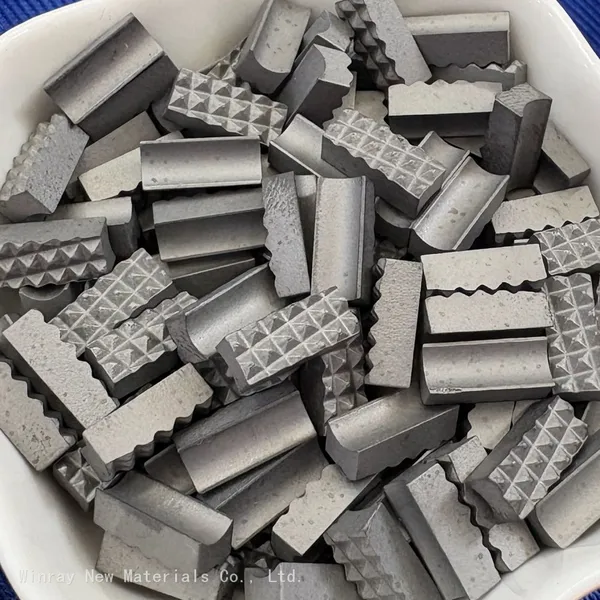
Tungsten Carbide Gripper Inserts for Oilfield Slip Assemblies – YG8/YG6/K10 Grades, High Hardness & Wear ResistanceNegotiableMOQ: 5 Kilograms

-
Precision Carbide Sleeves OD 5-50 mm ID 2-30 mm Concentricity Max 0.005 mm Ra 0.2 um CNC GroundNegotiableMOQ: 1 Unit
-
Submicron Tungsten Carbide Strips 2x8x330mm Ground Tolerance ±0.02mm HRA 92.0NegotiableMOQ: 10 Pieces
-
VSI Crusher Carbide Strips and Bars for Machine Tool Plane Blades Wood Cutting ToolsNegotiableMOQ: 10 Units
-
Yg8 Standard Tungsten Carbide Tips Ss10 for Stone Cutting ToolsNegotiableMOQ: 5 Kilograms
-
Tungsten Carbide Circular Saw Blade for Slitting Slotting Flat Tooth Saw Blades Cutting Metal Stainless Steel Aluminium Custom OEM Factory Bulk PriceNegotiableMOQ: 1 Blade
-
Tungsten Carbide Woodworking Blades – Replacement Cutting Blades for Wood Carving, Trimming & Planing ToolsNegotiableMOQ: 1 Box
-
Custom Carbide Wear Components From Samples and Prototypes to Volume Production WC-Co SupplierNegotiableMOQ: 10 Blades
-
Custom Tungsten Carbide Wear Parts Non-Standard Shapes Produced to Customer Drawings WC-CoNegotiableMOQ: 10 Blades
-
Tungsten Carbide Strips and Plates PYG7 Submicron Grade M10 Ultra High Strength Custom SizesNegotiableMOQ: 10 Blades
-
Tungsten Carbide Strips and Plates PK08 Grade K30 High Strength Impact Resistant Custom SizesNegotiableMOQ: 10 Blades