
 Business License

Carbide Punch Pin vs HSS Punch: Wear Life per 100,000 Strokes
1. Why Punch Cost per Stroke Is a Better Question Than Pins per Year
A terminal stamper a while back asked us to quote a punch pin against their annual consumption. The shop was buying roughly 240 HSS punches a year across six stations and had started treating that figure as the cost of punching. Nobody had divided the money by the holes those pins produced.
That division changes the answer. A carbide punch versus hss punch comparison run on purchase price puts carbide at four to six times the unit cost, and the same comparison run on cost per hole brings the two materials within a few percent of each other before scrap is counted.
The gap closes because the two materials fail on different schedules. A carbide punch versus hss punch decision made at the counter looks like a premium purchase, and the same decision made on a stroke counter looks like a maintenance argument. Which reading is correct depends entirely on how many strokes the station actually runs. Working in punch cost per stroke also makes the comparison portable between a slow press and a fast one.
This article sets out how to count strokes, what each material loses per 100,000 of them, and the conditions where HSS keeps the lower total. It stays on the piercing station and leaves press selection to the tool room.
2. Counting Strokes Before Any Punch Pin Wear Life Comparison
A punch pin wear life comparison is worth nothing without a stroke count behind it, and most shops do not record one. The press usually has a counter, and the counter is usually reset by whoever ran the last job rather than by whoever is tracking tool life.
The three records that make the comparison usable are the counter reading at each pin change, the number of holes per stroke, and the number of parts rejected per shift. The first two turn a pin change into a number of holes. The third is what later justifies the material change.
| Record | How to capture it | Accuracy | What it answers |
|---|---|---|---|
| Counter at pin change | Log the press counter before the tool is pulled | Exact | Strokes per pin, per station |
| Holes per stroke | Count piercing stations on the die layout | Exact | Converts strokes into holes |
| Run time at speed | Strokes per minute multiplied by logged hours | Within 5 percent | Cross-check when no counter exists |
| Rejects per shift | Sort bin weight divided by part weight | Within 10 percent | Scrap cost attributed to the station |
A shop running 300 strokes per minute on a single shift accumulates around 144,000 strokes a day. On that duty a pin change every two weeks is a 1.4 million stroke interval, which is a different conversation from a pin change every two weeks on a press running 60 strokes per minute.
Speed also changes the failure mode rather than the failure rate alone. Above roughly 400 strokes per minute the pin spends less time in the sheet and more time in the air, and the dominant damage moves from abrasive wear on the land to impact on the tip corner. Any punch pin wear life comparison that ignores stroke rate will overstate the carbide advantage on a slow press and understate it on a fast one.
3. Hardness Baseline of HSS, Powder Metal and Carbide Punches
Three materials turn up in the same quotation request, and their hardness figures are not directly comparable because they are measured on different scales. The table below converts them onto one line and adds the number that matters for this article, which is diameter lost per 100,000 strokes on 1 mm cold-rolled steel.
| Material | Hardness | Diameter loss per 100,000 strokes, 1 mm CRS | Edge behaviour |
|---|---|---|---|
| HSS, M2 class | 62 to 64 HRC | 0.010 to 0.020 mm | Deforms under overload, rarely chips |
| Powder metallurgy HSS | 64 to 66 HRC | 0.006 to 0.012 mm | Deforms, occasional micro-chip |
| Cemented carbide, WC-Co | HRA 89 to 92, about 1,400 to 1,600 HV | 0.002 to 0.005 mm | Holds diameter, chips if misaligned |
The carbide figure is a band rather than a value because cobalt content moves it. A 6 percent cobalt grade sits at the hard end and a 12 percent grade at the tough end, and the two behave differently on the same sheet even though both are sold as carbide. Winray keeps both ends of that range available and quotes the grade against the sheet thickness rather than against a catalogue default.
Hardness numbers also hide the heat story. HSS at 62 HRC starts to soften around 540 degrees Celsius, and a station running 400 strokes per minute with poor lubrication will reach that on the land. Carbide holds its hardness to well above 800 degrees, which is part of why the wear rate stays flat where HSS starts to climb.
4. The Three-Stage Wear Curve in a Carbide Punch Versus HSS Punch
Every punch wears in three stages, and the carbide punch versus hss punch difference is mostly in the length of the middle one. The first stage is a short break-in where the freshly ground land loses its sharpest edge. The second is a long steady climb. The third is acceleration as the land rounds over and friction rises.
On HSS the steady stage is steep enough to be visible on a weekly gauge check. A shop measuring hole diameter every shift will see the reading walk from the middle of the tolerance band toward the low limit over four to six weeks, and that walk is the steady stage doing its work.
On carbide the steady stage is close to flat for most of the pin life, then turns up sharply near the end. That shape is more dangerous than a gentle slope because the gauge reads acceptable and then unacceptable within a short interval, which is why carbide stations need a fixed change interval rather than a condition check.
Chip resistance belongs in the same conversation. A carbide pin that meets a 0.03 mm offset between punch and die button will chip a corner and keep cutting a crescent-shaped hole. The same offset on HSS produces a rolled edge and a slower, more visible decline, which is easier to catch but no cheaper to fix.
5. Punch Diameter Drift per 100,000 Strokes Against Hole Tolerance
Life ends when the hole leaves tolerance, not when the edge stops cutting. That distinction turns a wear rate into a service interval, and the conversion needs the starting position inside the tolerance band as well as the wear rate itself.
| Work material | HSS, strokes to exit a 0.03 mm band | Powder metal | Cemented carbide |
|---|---|---|---|
| 0.5 mm cold-rolled steel | 150,000 | 250,000 | 600,000 |
| 0.8 mm cold-rolled steel | 120,000 | 200,000 | 450,000 |
| 1.5 mm 304 stainless | 70,000 | 120,000 | 260,000 |
| 3 mm hot-rolled plate | 40,000 | 70,000 | 150,000 |
Stainless shortens every interval because it work-hardens under the punch nose and because it adheres to the land. Adhesion is a wear mechanism that hardness does not fully answer, so the carbide gain on 304 is smaller than the gain on cold-rolled steel even though the absolute numbers still favour carbide. A punch pin wear life comparison run on stainless therefore reads differently from the same exercise on low-carbon sheet.
A pin ground to the top of the tolerance band gets more strokes before the hole exits the bottom than a pin ground to the middle. That is a real and free gain, and it comes from the drawing rather than from the material.
Winray New Materials grinds punch pins to the diameter the die designer asks for, with h6 or h7 held on request and concentricity between tip and shank at 0.005 mm. A pin that runs true wears around its circumference instead of on one side, and a one-sided wear pattern will halve any interval in the table above.
6. Building a Punch Cost per Stroke Number You Can Defend
A punch cost per stroke number has to carry three items, and most quotations carry one of them. The three are the pin purchase price, the cost of the downtime to change it, and the scrap produced while the hole is drifting toward the limit.
The worked example below uses a 0.8 mm cold-rolled steel part, 300 strokes per minute, one hole per stroke, and a tool change that takes 12 minutes with the line stopped at a cost of roughly 1.20 dollars a minute. All figures are per one million strokes.
| Line item | HSS | Powder metal | Cemented carbide |
|---|---|---|---|
| Usable life per pin | 150,000 strokes | 200,000 strokes | 450,000 strokes |
| Pins consumed per million | 7 | 5 | 3 |
| Pin cost at 9 / 24 / 62 dollars | 63 dollars | 120 dollars | 186 dollars |
| Downtime, 12 minutes per change | 101 dollars | 72 dollars | 43 dollars |
| Scrap at the end of each life | 840 dollars | 560 dollars | 175 dollars |
| Total per million strokes | 1,004 dollars | 752 dollars | 404 dollars |
The pin line is the one that goes up when the material changes, and it goes up by a factor of three. Everything else falls. The scrap line falls hardest because the last 20 percent of a worn pin's life is where the rejected parts concentrate.
That is the sentence worth carrying into a quotation meeting. The pin is the least expensive item in the decision and the most expensive item in the failure, and a purchasing comparison that weighs the pin alone is weighing the smaller half of the number. Winray runs this arithmetic with customers who ask for a punch cost per stroke figure before they commit to a material change.
7. When a Punch Pin Running HSS Keeps the Lower Total Cost
Carbide does not win everywhere, and a supplier who says it does has not run the arithmetic on a slow press. The material change pays back in proportion to strokes, so the first condition for keeping HSS is low stroke count.
Below roughly 80 strokes per minute the downtime term dominates the calculation and the wear term fades. At 60 strokes per minute a million strokes takes 278 hours, which is seven weeks of single-shift running, and the difference between seven and three pin changes in that window is a rounding error against the tool cost increase.
Heavy plate is the second case. On 4 mm and above, the impact load on a small punch pin is high enough that chipping rather than wear decides life, and a chipped pin does not wear out gradually. HSS deforms and keeps cutting, which is a bad outcome on a tolerance chart and a good outcome on a delivery schedule. A punch pin wear life comparison taken from a 0.8 mm job and applied to 4 mm plate will overstate the carbide interval by a wide margin.
Complex edge profiles are the third. A punch with an internal corner, a notch or a stepped profile is ground on a profile grinder in HSS at a cost that carbide cannot match at low volume. The same profile in carbide is worth it once the annual volume passes a few hundred thousand strokes. Winray quotes those profiles in both materials so the crossover can be seen on paper rather than guessed at.
8. Four Fixes to Make Before Changing a Punch Pin Material
Switching to carbide on a die that has an alignment problem converts a wear issue into a breakage issue. The four checks below are the ones we ask about before quoting a carbide pin for a station that has been running HSS. A carbide punch versus hss punch change made before the die is aligned will fail inside a shift rather than inside a season.
| Check | Target | What it costs if ignored |
|---|---|---|
| Cutting clearance | 5 to 8 percent of thickness per side | Rolled edge, then corner chip |
| Tip to die button concentricity | Within 0.03 mm | Crescent hole and side load |
| Stripper force | 5 to 10 percent of piercing force | Slug pull and tip impact on return |
| Lubrication at the land | Continuous film at the cutting edge | Adhesion on stainless and aluminium |
Clearance is the one that gets adjusted without being recorded. A die that has been shimmed twice will have a clearance nobody knows, and putting a harder pin into that station moves the failure from the edge to the tip corner within a shift.
Stripper force is the second most common omission. A weak stripper lets the sheet lift with the punch on the return stroke, and the tip takes an impact on the next descent that no carbide grade survives indefinitely.
Winray New Materials Co Ltd asks for the die layout and the clearance figure with every custom pin order, and quotes a grade against the sheet rather than against the customer's previous supplier. A grade chosen for 3 mm plate and then run on 0.5 mm sheet will chip at the corner before it wears at the land.
9. Frequently Asked Questions About Punch Pin Wear Life and Cost
9.1 How Do I Estimate Punch Cost per Stroke for a New Part?
Start from the strokes to tolerance exit rather than from the pin price. Take the tolerance band, divide it by the wear rate for the material and thickness, and you have a pin interval in strokes. Divide the pin price plus the change downtime by that interval and the result is cost per stroke. When the part is new and no wear rate exists, use 0.015 mm per 100,000 strokes for HSS on 1 mm steel and 0.004 mm for carbide, then correct the figure after the first pin change on the real station.
9.2 Does a Carbide Punch Versus HSS Punch Comparison Change on Stainless?
Yes, and the change is smaller than buyers expect. Stainless work-hardens under the punch nose and tends to adhere to the land, which is a wear mechanism that hardness answers slowly. Carbide still lasts two to three times as long as HSS on 304, against three to four times on cold-rolled steel. A punch pin wear life comparison on stainless also has to allow for galling, so a 304 station running carbide needs a lubrication check on the same schedule as a gauge check, and the lubrication interval belongs on the same card.
9.3 Can a Worn Carbide Punch Pin Be Reground Like an HSS Punch?
It can, with limits. A carbide pin is normally reground once, removing 0.05 mm to 0.10 mm of diameter to restore the land, and the diameter then sits below the original nominal. That matters on a station running at the tight end of a clearance spec, because the clearance grows with every regrind. Diamond grinding also costs more per pass than the aluminium oxide wheel used on HSS, and we quote regrind allowance into the first order so the customer knows how many cycles the pin will take.
9.4 What Stroke Rate Makes Carbide Worth the Price Difference?
On a single-station die the crossover usually lands between 120 and 150 strokes per minute for 0.5 mm to 1.5 mm steel. Below that the downtime term is too small to recover the tool cost inside a reasonable payback. Above 250 strokes per minute the arithmetic is not close, and the scrap term carries the decision on its own. For multi-station progressive dies the crossover drops, because one pin change stops the whole die rather than one station, and that multiplied downtime is what pushes most high-speed progressive work onto carbide.
Recently Posted
-
Carbide Punch Pins in Progressive Die Piercing of Sheet Metal
November 18, 20261. Progressive Die Punch Pin Loads at 300 Strokes a Minute A progressive die punch pin does not do one job. It does the job of its Read More
-
How to Order Custom Carbide Punch Pins From a Drawing
November 17, 20261. Why a Punch Pin Drawing Carries More Than a Part Number A part number describes a pin that already exists. Beyond the standard
Read More -
Solid Carbide Punch Pin vs Coated Punch: Which Holds Diameter Longer
November 17, 20261. Why a Solid Carbide Punch Pin and a Coated Punch Are Compared Wrong A solid carbide punch pin is usually compared with a coated Read More
-
Carbide Punch Pin Anatomy: Head, Shank, Tip and Where Each Part Fails
November 16, 20261. Carbide Punch Pin Anatomy: The Three Zones and Why the Split Matters A punch pin ground to the right diameter still fails when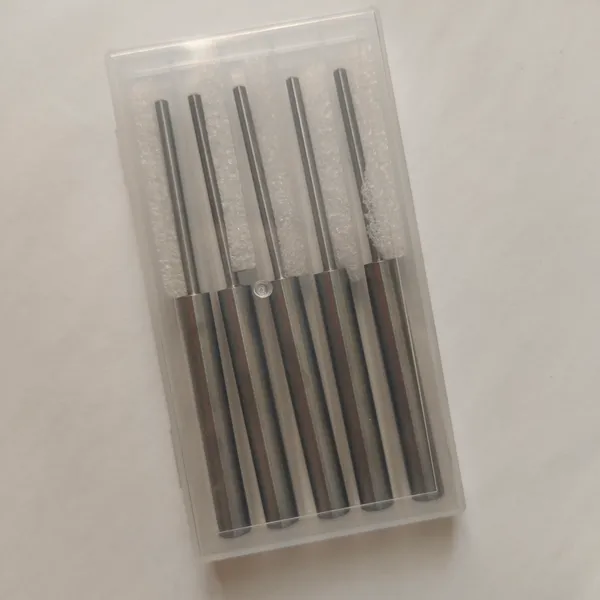 Read More

Contact Us
Recommended Products
-
 Non-Magnetic Nickel-Bonded Cemented Carbide Molds, Submicron Grain, Mirror Polished CavitiesNegotiableMOQ: 1 Blade
-
Non-Magnetic Carbide Grades for Specialized MoldsNegotiableMOQ: 1 Unit
-
Tungsten Carbide Punches HRA 90.5 Co 10% +/-0.002 mm Tolerance Mirror-Polished for Stamping DiesNegotiableMOQ: 1 Unit
-
Custom Carbide Strips and Round Blanks With 0.05mm Flatness for Machine ToolingNegotiableMOQ: 1 Unit
-
Custom Cemented Carbide Blanks ISO Standard Compliant With Ra 0.4 Surface FinishNegotiableMOQ: 1 Unit
-
Precision Ground Carbide Inserts and Blanks – Custom Grades and Tolerances up to ±0.01mmNegotiableMOQ: 1 Unit
-
Ground Carbide Rods Ø8mm x 200mm, h6 Tolerance, Ra 0.4μm, HRA 91.0NegotiableMOQ: 10 Units
-
Polished Tungsten Carbide Hollow Rods for Precision Machining ApplicationsNegotiableMOQ: 1 Piece
-
Tungsten Carbide Saw Tips for TCT Circular Saw Blades and Woodworking CuttingNegotiableMOQ: 100 Pieces
-
Tungsten Carbide Gripper Inserts for Oilfield Slip Assemblies – YG8/YG6/K10 Grades, High Hardness & Wear ResistanceNegotiableMOQ: 5 Kilograms

-
Precision Carbide Sleeves OD 5-50 mm ID 2-30 mm Concentricity Max 0.005 mm Ra 0.2 um CNC GroundNegotiableMOQ: 1 Unit
-
Submicron Tungsten Carbide Strips 2x8x330mm Ground Tolerance ±0.02mm HRA 92.0NegotiableMOQ: 10 Pieces
-
VSI Crusher Carbide Strips and Bars for Machine Tool Plane Blades Wood Cutting ToolsNegotiableMOQ: 10 Units
-
Yg8 Standard Tungsten Carbide Tips Ss10 for Stone Cutting ToolsNegotiableMOQ: 5 Kilograms
-
Tungsten Carbide Circular Saw Blade for Slitting Slotting Flat Tooth Saw Blades Cutting Metal Stainless Steel Aluminium Custom OEM Factory Bulk PriceNegotiableMOQ: 1 Blade
-
Tungsten Carbide Woodworking Blades – Replacement Cutting Blades for Wood Carving, Trimming & Planing ToolsNegotiableMOQ: 1 Box
-
Custom Carbide Wear Components From Samples and Prototypes to Volume Production WC-Co SupplierNegotiableMOQ: 10 Blades
-
Custom Tungsten Carbide Wear Parts Non-Standard Shapes Produced to Customer Drawings WC-CoNegotiableMOQ: 10 Blades
-
Tungsten Carbide Strips and Plates PYG7 Submicron Grade M10 Ultra High Strength Custom SizesNegotiableMOQ: 10 Blades
-
Tungsten Carbide Strips and Plates PK08 Grade K30 High Strength Impact Resistant Custom SizesNegotiableMOQ: 10 Blades