
 Business License

The Unseen Edge: Why Hard Alloy Saw Tips Quietly Decide Whether a Saw Cuts or Fails
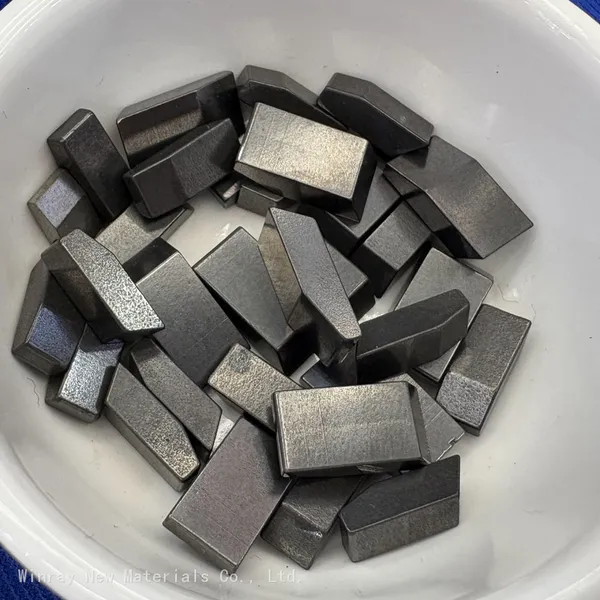
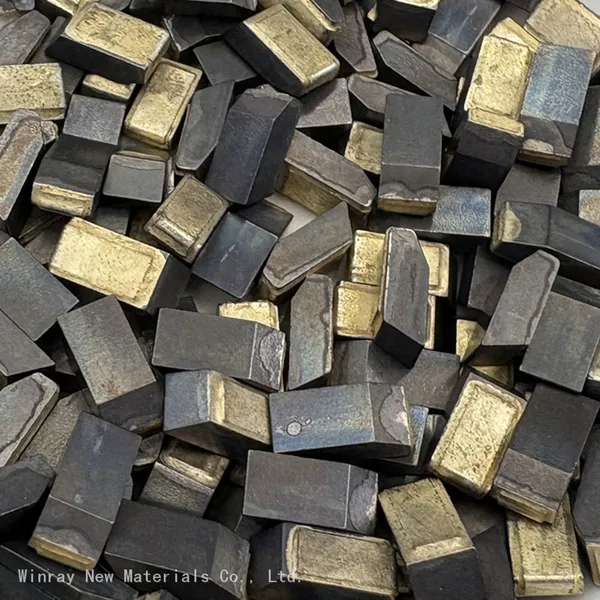
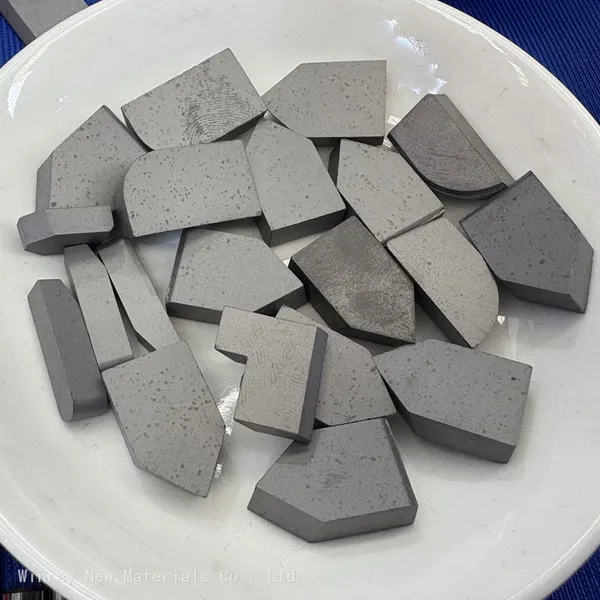
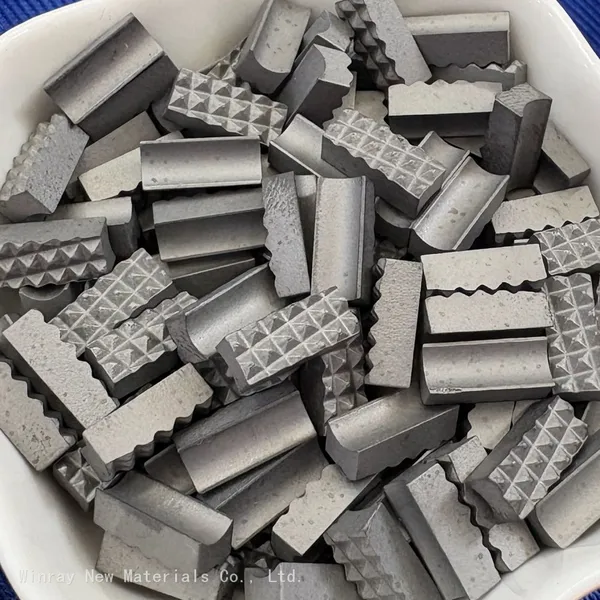
Walk into any serious saw shop—the kind that services blades for lumber mills, metal fabricators, or precision panel processors—and you will notice a particular hierarchy of attention. The blade body gets inspected for cracks and tension. The gullets are examined for fatigue. The brazing is checked for voids. But the tiny, gray, almost unassuming slivers of material welded to the very tip of each tooth? Those are the hard alloy saw tips, and they are the reason the entire operation exists.
Hard alloy, more commonly called cemented tungsten carbide in the trade, is not a single material but a carefully engineered composite. It is a marriage of tungsten carbide particles—extraordinarily hard and wear-resistant—held together by a cobalt binder that provides the toughness needed to survive the brutal impact of cutting . Get the balance right, and a saw tip can shear through hardwood, stainless steel, or aluminum for hours without losing its edge. Get it wrong, or simply select the wrong grade for the job, and you will be sharpening, replacing, or scrapping blades far more often than your production schedule allows.
This article is a practical guide to hard alloy saw tips for the people who specify, braze, grind, and use them. It is not a sales brochure. It is an attempt to explain why these small components matter so much, how they are chosen, and where the technology is quietly heading.
What “Hard Alloy” Actually Means at the Tip
The term “hard alloy” is a loose translation of what English-speaking metallurgists call cemented carbide or tungsten carbide. The basic recipe has been understood for nearly a century: tungsten carbide powder (WC) is mixed with a metallic binder, usually cobalt (Co), pressed into shape, and sintered at high temperature. The result is a material with hardness approaching that of some ceramics, but with enough transverse rupture strength to withstand the interrupted cutting forces of a saw tooth .
The critical variable is the ratio of carbide to cobalt, and the grain size of the carbide particles. A tip with high cobalt content—say 10 to 15 percent—will be tougher and more resistant to shock, making it suitable for rough milling or cutting abrasive, inconsistent materials. A tip with lower cobalt and finer grain structure will be harder and more wear-resistant, ideal for clean, high-speed cutting where edge retention matters more than impact resistance . This is why a reputable supplier will offer a portfolio of grades rather than a single “one-size-fits-all” tip.
For woodworking applications, grades in the K10 to K30 range are common, balancing wear resistance with the toughness needed to survive knots and occasional foreign objects. For metal cutting—especially ferrous alloys and stainless steel—the demands shift. The tip must resist not just abrasion but also the heat generated by cutting steel, and it must maintain edge integrity under higher cutting forces. Cermet tips, which use a ceramic phase in a metallic matrix rather than pure tungsten carbide, offer an alternative for finishing cuts on steel where surface finish and wear resistance are paramount .
What matters most for the person specifying a tip is not memorizing ISO grade codes, but understanding the failure mode they are trying to avoid. Is the tip chipping? The grade is too hard or the brazing is poor. Is the tip wearing flat too quickly? The grade is too soft for the material’s abrasiveness. Is the tip cracking after brazing? The cooling cycle was too aggressive, or the tip geometry created a stress concentration.
The Geometry Problem: Small Changes, Large Consequences
A saw tip is not a generic cube of carbide. Its geometry—rake angle, clearance angle, side angles, and corner radius—determines how it enters the cut, how chips form, and how heat is distributed. And because the tip is brazed to a steel tooth, its geometry also affects how stress travels through the joint.
Consider a recent development in band saw blade design for cutting difficult alloys like Inconel 718. A patent filing describes a tooth profile where the rear angle was increased from the traditional 20 degrees to 25 degrees, with the explicit goal of reducing cutting force and improving chip formation . The inventors note that since 1986, the 20-degree rear angle had been the standard for carbide band saw tips, primarily to prevent vibration. But testing showed that a steeper angle could reduce the load on each tooth without causing unacceptable vibration, provided the tooth set and height sequencing were designed correctly .
This is a useful reminder that saw tip performance is never just about the carbide grade. A premium tip brazed to a poorly designed tooth with an inappropriate rake angle will underperform a standard tip on a well-engineered tooth. The interaction between tip and tooth body is where the real engineering happens.
The rake angle—the angle at which the tip’s face meets the material—is particularly consequential. For carbide in woodworking, positive rake angles are common because they slice rather than scrape, reducing cutting forces. For metal cutting, the optimal rake angle depends on the material’s tendency to work-harden and the rigidity of the machine. A tip that is ground with too aggressive a rake angle may cut freely but will chip under interrupted cuts; too conservative an angle will generate heat and shorten tip life.
Then there is the brazing joint itself. The tip must be joined to the steel tooth with enough strength to survive cutting forces, but without introducing stresses that crack the carbide during cooling. The traditional method—brazing with a silver-based filler—remains standard, but the preparation of the tooth seat matters enormously. Research from as far back as the 1950s recognized that a thin saw body provided insufficient bearing area for a secure braze, leading to tip loss . Modern practice involves precise milling of the tip seat, controlled braze gap, and careful post-braze cooling to minimize thermal stress.
Choosing the Right Tip for the Job
The practical question for most shops is not the metallurgy of cobalt binders but a simpler one: which tip do I order for this blade?
The first distinction is the workpiece material. Wood, aluminum, steel, and stainless steel each impose different demands. For wood and wood-based panels, standard tungsten carbide grades with moderate cobalt content handle the abrasiveness of engineered woods and the shock of knots reasonably well. For aluminum, the tip needs to be sharp and resistant to built-up edge, which means a polished face and a grade that resists adhesion wear. For steel, especially stainless, the tip must resist high temperatures and not react with the workpiece material—hence the growing interest in cermets for finishing applications .
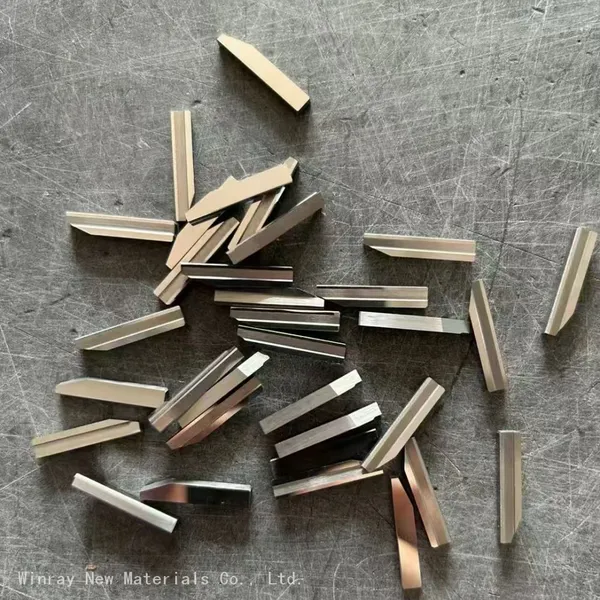
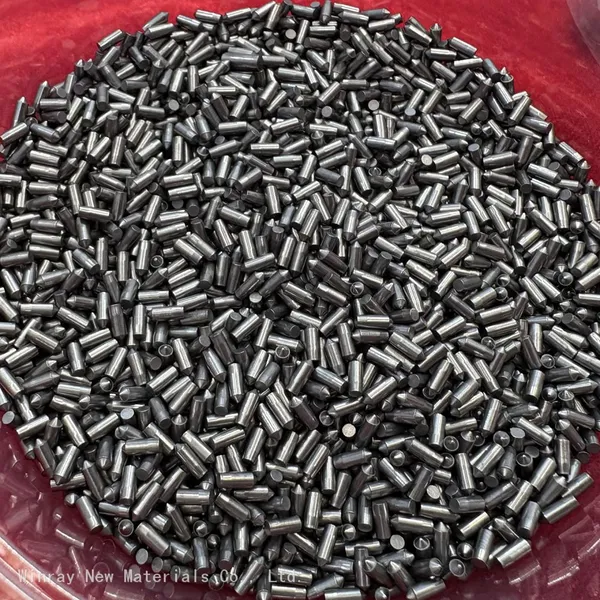
The second distinction is the saw type. Circular saw tips are typically larger and more varied in geometry than band saw tips. Band saw tips are often supplied as small cylinders or blocks that are welded or brazed to the tooth and then ground to final form . The small size of band saw tips makes handling and brazing more delicate, but it also means less carbide is wasted when the tip reaches the end of its life.
The third distinction is the machine and the operation. A high-production moulder running at constant feed and speed can use a more wear-resistant, harder grade because the cutting conditions are predictable. A portable bandsaw or a job shop saw that encounters varied materials and occasional operator error needs a tougher grade that will tolerate abuse. This is why serious tip suppliers ask about the application before recommending a grade—and why a shop that simply orders “the usual” may be leaving performance on the table.
The Sharpening Question
A hard alloy tip is not permanently sharp. It wears, and when it does, the choice is to sharpen or replace. For circular saw blades, sharpening is routine: the tip is ground on a diamond wheel to restore the cutting edge. The geometry of the tip—especially the clearance angle—must be maintained, because a tip that is sharpened with too little clearance will rub rather than cut, generating heat and shortening the blade’s life.
For band saw blades, sharpening is more common than tip replacement in many shops, but the economics shift as blade widths decrease. A narrow band saw blade with tiny tips may not have enough carbide to survive multiple sharpenings, making replacement the more practical option.
What is often overlooked is that sharpening is not a neutral operation. Every grinding pass removes a small amount of carbide and introduces a small amount of heat. A tip that is overheated during sharpening can develop microcracks that lead to premature failure. A tip that is ground with too coarse a diamond wheel will have a rough edge that wears faster than a properly finished edge. The quality of the sharpening room often determines whether a premium tip delivers premium performance or merely average results.
Where the Technology Is Heading
The basic architecture of the carbide saw tip—a small piece of cemented carbide brazed to a steel tooth—has been stable for decades. But the margins are being pushed in several directions.
One direction is finer grain and higher hardness. Submicron and ultrafine carbide grades allow tips to be made harder without becoming unacceptably brittle, extending edge life in abrasive materials like medium-density fiberboard and composite panels . Another direction is the use of alternative materials for specific applications. Polycrystalline diamond (PCD) and cubic boron nitride (CBN) tips are significantly harder than tungsten carbide, but they are also more expensive and more difficult to braze and sharpen. For most woodworking and general metal cutting, carbide remains the economic sweet spot. But in high-volume machining of abrasive composites or hard metals, the calculus can favor ultrahard materials .
A third direction is the integration of tip design with tooth design. The band saw patent mentioned earlier is an example: the tip is not treated as a standalone component but as part of a system that includes tooth height, set pattern, and rake angle . As cutting tools become more specialized for difficult materials—nickel alloys, titanium, composites—this systems approach will become more important. The tip that works for cutting mild steel will not necessarily work for cutting Inconel, and the differences are as much about geometry as about grade.
Finally, there is the quiet but persistent pressure on consistency. A saw tip is a small, inexpensive component relative to the blade it sits on and the machine it runs in. But a single tip that fails prematurely can damage the workpiece, stall the machine, or ruin the blade body. For suppliers, the challenge is not just making a hard alloy with the right properties, but making every tip in every batch with the same properties, so that the blade builder and the end user can trust the process.
A Final Word for the People Who Specify Tips
If there is a single takeaway from the study of hard alloy saw tips, it is that these components deserve more attention than they typically receive. The difference between a good tip and a mediocre one is not always visible to the naked eye. It lives in the grain size of the carbide, the cobalt content, the precision of the brazing seat, and the care taken in grinding.
For the shop that specifies tips, the practical advice is straightforward. Know the material you are cutting and its failure modes. Ask your supplier for grade recommendations based on the actual application, not just a catalog number. Pay attention to the brazing process—a premium tip joined poorly will fail like a cheap one. And do not underestimate the sharpening room: a blade is only as good as its last grind.
The saw tip is the smallest component in the cutting system, but it is the one that touches the work. Everything else—the motor, the feed mechanism, the blade tension—exists to position that tiny piece of hard alloy correctly and keep it there. When the tip is right, the cut is quiet, the chips fly clean, and the blade lasts. When it is wrong, nothing else matters.
Recently Posted
-
Choosing the Right Cemented Carbide Rod for Your Application
October 30, 2026Cemented carbide round rods look deceptively simple: a dense, grey, cylindrical blank. Yet behind that uniform appearance lies a c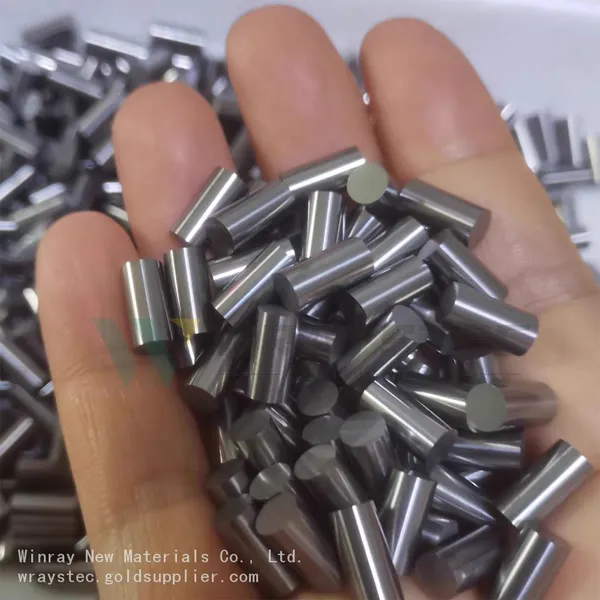 Read More
-
Why "One Piece" Is the Future of Custom Tungsten Carbide Wear Parts
October 30, 2026In the world of industrial manufacturing, the phrase "minimum order quantity" (MOQ) has long been a source of frustratio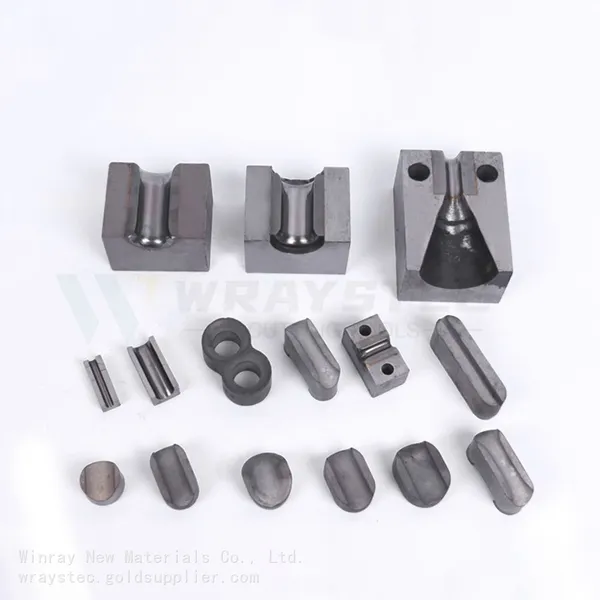 Read More
-
Cemented Carbide Wolf Tooth Rod (YD-Type Hardfacing Rod)
October 30, 2026In the field of industrial wear protection, the "Cemented Carbide Wolf Tooth Rod" does not refer to a physical striking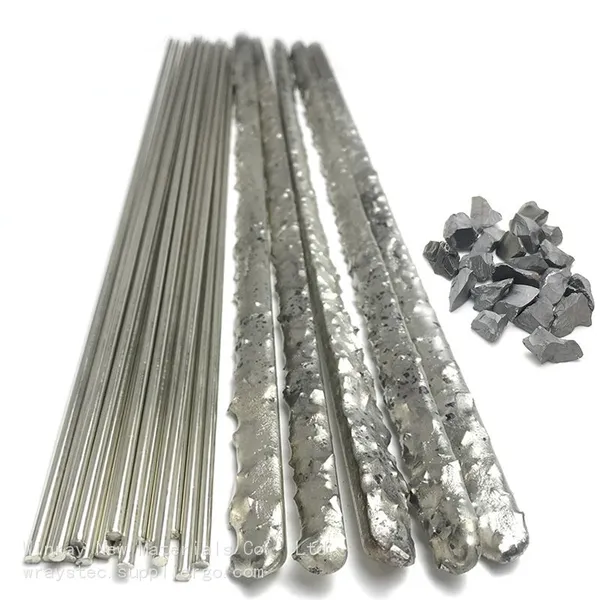 Read More
-
Why "One Piece Minimum" Is the Most Underrated Advantage in Carbide Machining
October 30, 2026If you've ever tried to source custom tungsten carbide components, you've probably run into the same wall: minimum order q Read More

Contact Us
Recommended Products
-
 Precision Ground Carbide Base Plate, 94.0 HRA, 0.4μm Surface Finish, 100mm x 100mm x 5mm for Die ComponentsUS$ 1.55MOQ: 10 Units
-
Tungsten Carbide Substrate Disc, Dia 30mm x 2.5mm, 25MPa Transverse Rupture Strength, Flatness 0.02mmUS$ 1.55MOQ: 10 Units
-
Carbide Substrate for Indexable Cutting Tools, ISO 1832 Compliant, 10mm x 10mm x 4.76mm, 93.0 HRA, Flat Grinding FinishedUS$ 1.55MOQ: 10 Units
-
Supplier-Provided Carbide Base Material With Technical Data Sheet, 94.0 HRA, 0.4μm Ra Finish, 30-Day Replacement for Machining ErrorsUS$ 1.55MOQ: 10 Units
-
EDM Wire-Cut Carbide Base Strip, 150mm x 20mm x 3mm, 89.5 HRA, Ra 0.6μm, Parallelism 0.01mmUS$ 1.55MOQ: 10 Units
-
Unmounted Carbide Substrate Blank, 305mm x 305mm x 2.0mm, 90.0 HRA, Micro-Grain WC-Co 10% Co CompositionUS$ 1.55MOQ: 10 Units
-
Carbide Substrate With 12-Month Warranty, Mill Test Report Included, 90.0 HRA, CNC Ground, Sizes Tailored to BlueprintUS$ 1.55MOQ: 10 Units
-
Cemented Carbide Substrate WC-Co Grade 6.0% Co, 90.5 HRA Hardness, 10mm x 10mm x 3.2mm Ground Tolerance ±0.05mmUS$ 1.55MOQ: 10 Units
-
Carbide Base Plate for Precision Mold Manufacturing, 5mm Thick, 60 x 60mm, 0.005mm Perpendicularity, Corrosion-Resistant GradeUS$ 1.55MOQ: 10 Units
-
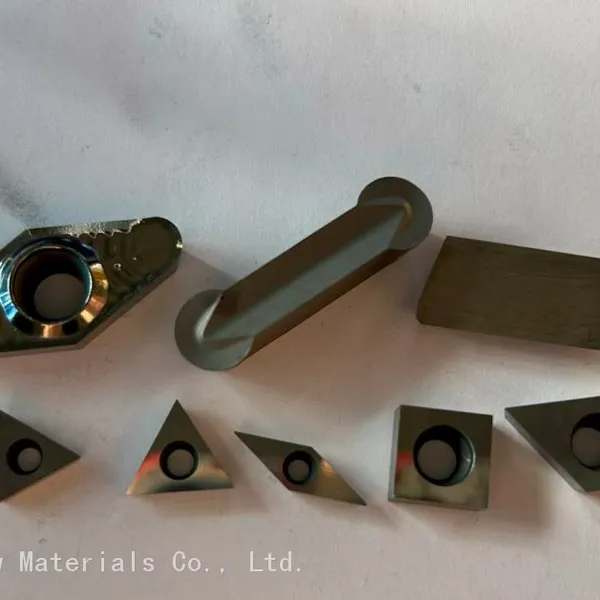
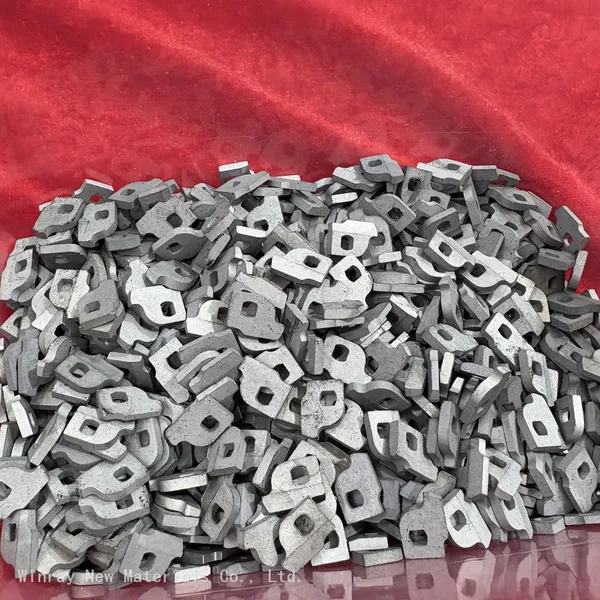
YG8 Grade Carbide Saw Tips 25x5x1.5mm Tungsten Carbide Blade Inserts Hardness 1560HV for Sawmill UseNegotiableMOQ: 10 Kilograms
-
Slot Style Carbide Saw Tips Tungsten Alloy Hardness 90HRA Grind Tolerance ±0.02mm for Auto Sharpening MachinesNegotiableMOQ: 10 Kilograms
-
Mill Test Report Provided Carbide Saw Tips YG8 12-Month Warranty Against Edge Chipping for Wholesale BuyersNegotiableMOQ: 10 Kilograms
-
Carbide Saw Tips for MDF and Plywood Processing YG6X Tungsten Carbide Fine-Grain Grade for Panel Plant Saw BladesNegotiableMOQ: 10 Kilograms
-
Flat Top Carbide Saw Tips 30x8x3mm With 5 Degree Clearance Angle Tungsten Carbide Inserts for Scoring BladesNegotiableMOQ: 10 Kilograms
-
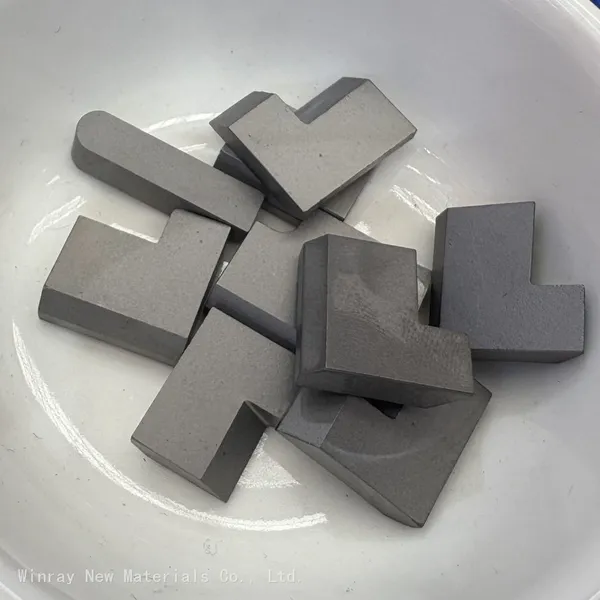
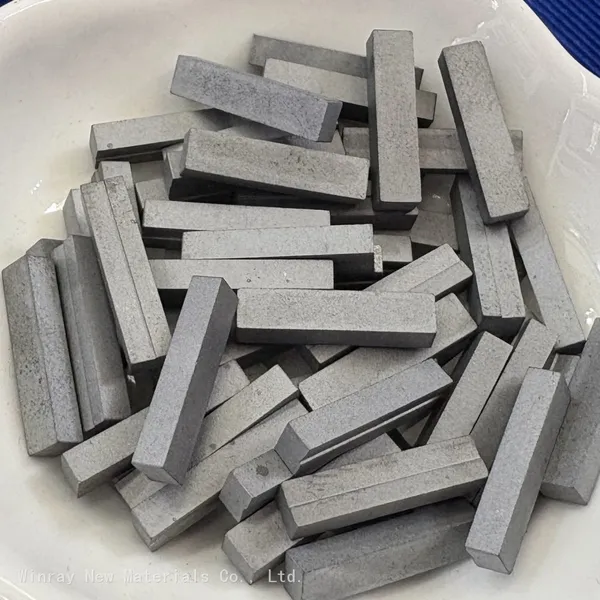
Carbide Saw Tips 12 Degree Clearance Angle WC-Co Density 14.8 G/cm3 Standard Compliant for Hardwood Cutting BladesNegotiableMOQ: 10 Kilograms
-
K20 Tungsten Carbide Saw Tips WC-Co Micro-Grain 0.8μm 1800HV for TCT Circular Saw Blade Re-tippingNegotiableMOQ: 10 Kilograms
-
Carbide Saw Tips With Grinding Technical Support 24-Month Warranty OEM Dimension Customization ServiceNegotiableMOQ: 10 Kilograms
-
Shear Cut Carbide Saw Tips 1.5mm Thickness 88-92HRA Silver Brazing Grade for Industrial Saw Blade ManufactureNegotiableMOQ: 10 Kilograms
-
Sintered Carbide Wear Plates With 2500 MPa Transverse Rupture Strength for Heavy Industrial EquipmentNegotiableMOQ: 1 Piece
-
Carbide Wear Parts for Mining Excavator Bucket Teeth and Crusher Hammer Tips - 350 MPa Impact ToughnessNegotiableMOQ: 1 Piece